business fact profile v10 · tamper-evident history · measured on 12 sites
AI agents misread your website. We measured it. We fix it. We prove it.
An agent arriving at your website reads one page and answers from it. We measure what it gets wrong, put the missing answers where it actually reads, and measure again.
- What we sell
- An agent-readiness package for a business website: a homepage fact block that answers the questions buyers ask, a where-to-go index for agents, a machine-readable fact sheet at llms.txt and llms-full.txt, an identity card, robots.txt pointers, structured data for search, and a before/after measurement of what agents recover from your site. Every surface is generated from one signed-off profile, so no two can disagree.
- Buy or rent
- The package is bought once and is yours to keep, including the source files. Monthly monitoring and the update loop are a subscription you can stop at any time; stopping it leaves everything installed and working.
- Where we work
- Delivered remotely and installed on any platform that lets you paste HTML and upload two text files. We hand you a kit to install yourself, or we install it for you.
- How long we have done it
- Measuring how agents read business websites since June 2026, across 12 real company sites and several hundred recorded agent visits. Forty-one numbered measurement notes, retractions included.
- What our credentials mean for you
- No badge, no accreditation: every number we publish cites the numbered note that produced it, and those notes record the failures, the retractions and the two claims we killed ourselves. If a claim on this site has no citation beside it, hold us to it.
- Industries and customers served
- Agencies installing this for their own clients, contractors and trades, manufacturers and equipment suppliers, professional services firms, and any business whose buyers now ask an assistant before they ask a human.
- After the sale
- A one-page install guide written for your platform, a before/after audit of what agents recover from your site, monthly monitoring for drift, and the update loop: when a fact changes you edit one profile and every surface regenerates in a single run.
- What does it cost
- The free audit costs nothing. Audit + Kit is 149 USD once and is yours to keep, including the source files. Agent-Ready is 149 USD per month. Pro is 299 USD per month and covers three sites. Managed starts at 500 USD per month and is scoped in a conversation rather than a checkout. Prices are per site, in US dollars, and are published on the order page in the same numbers.
- What exactly do I get
- Eight surfaces from one profile, plus a manifest that records who signed the facts off and when: the homepage fact block, the where-to-go index, the identity card, llms.txt, llms-full.txt, robots.txt additions, structured data, and a hosted version-history page.
- Does this change how my website looks
- No. The fact block wraps the paragraph your homepage already shows under its headline, keeping your own typography. A visitor sees no change; a click opens a small panel of plain facts.
- How do you know it works
- Measured, not asserted. In the strongest arm, agents recovered 78 per cent of a site's key facts with the block in place against 30 per cent without it, and they stopped after an average of 1.1 pages. On a live client site, two facts that had been unrecoverable went to full recovery, and the two we deliberately left out stayed unrecovered.
- What does this have to do with Google
- Google's page-quality tooling now audits websites for agent-readiness, including whether the site publishes a machine-readable fact sheet in the expected format. The package passes the llms.txt and page-structure checks of Google's agent-readiness audit; the WebMCP audits cover interactive tools a fact package deliberately does not install. Three of the six audits in that category are WebMCP checks, so nobody should read this as a clean sweep. We make no claim that any of it improves search position.
- What happens when a fact changes
- You tell us the change. One command edits the profile, regenerates every surface, adds a new version to the published history, and re-runs the audit. Hand-editing one file is how a website ends up telling agents two different prices, which is the most common defect we find.
- What is the version history for
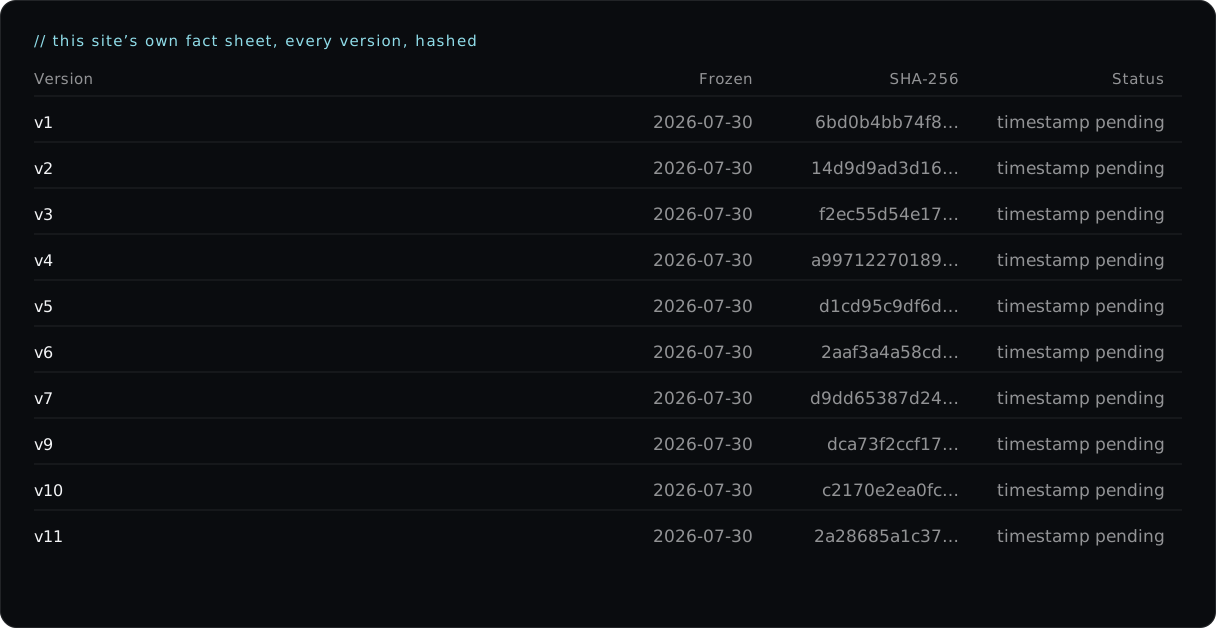
- Every version of your fact sheet is hashed and published with its hash, superseded versions included, so the history is tamper-evident: change a byte and the fingerprint changes with it. Anchoring those hashes in a public ledger is the step that adds an independent timestamp, and it is not live yet, so our own history page reads timestamp pending on every row. It never verifies identity, and it never attests that the facts are true.
- Not published here
- Client names we do not have written permission to publish, any result we have not measured ourselves. Ask us directly.
- Fact sheet history
- Tamper-evident version history: https://aigentsphere.ai/stamp/aigentsphere.ai/
That paragraph is clickable. It is this page’s own hero copy, wrapped so that an agent reading the page gets our facts on its first and usually only fetch. You are looking at the product.
We find what AI gets wrong about your business, fix it at the source, and prove the improvement.
Audit + Kit
149 USD once
Six models audit your site, you get the fix package and keep it.
Agent-Ready
149 USD per month
The kit, plus monthly re-audits and an alert when your pages drift.
Pro
299 USD per month
Three sites, competitor benchmarking and priority re-audits.
Per site, in US dollars. The free audit is one model reading your homepage and telling you what it could not find; everything above it fixes what the audit shows and measures again. There is a managed tier above these three, scoped in a conversation rather than published as a price. You can also watch an agent read a page we prepared.
the measurement
The pitch is the measurement
An agent sent to a business website does not browse it. It fetches the homepage, reads what is in the bytes, and answers from that. Across twelve real company sites and several hundred recorded agent visits, the same failures kept appearing: agents could not find a price, could not tell whether a thing was for sale or for rent, and confidently attributed facts to the wrong company.
So we built the fix as an experiment with a control arm, and ran it.
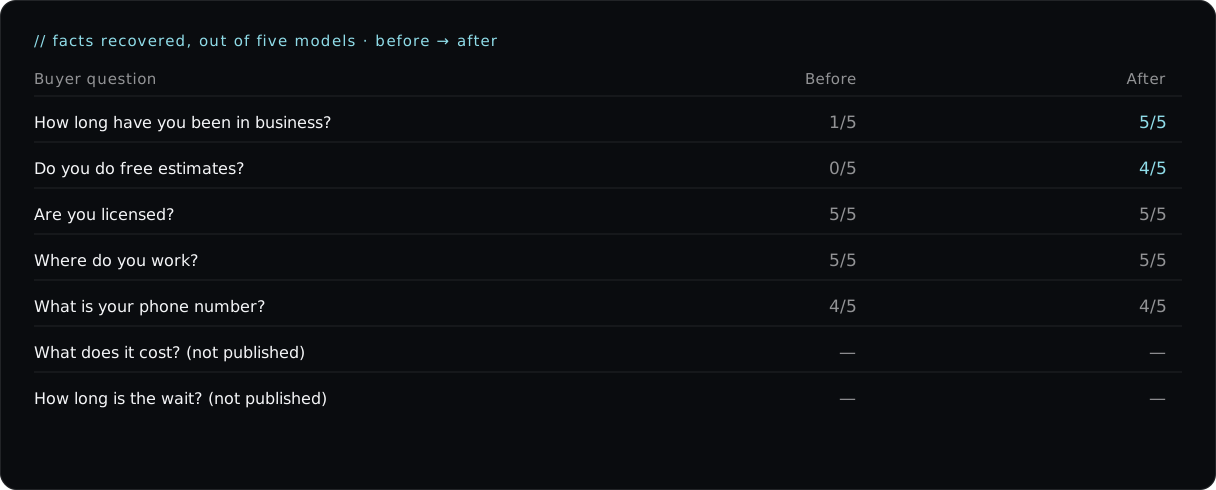
| Arm | Facts recovered | Pages fetched |
|---|---|---|
| No fact block (control) | 30% | — |
| Fact block behind the site’s own hero paragraph | 78% | 1.1 |
Measured 2026-07-29, 2 runs × 6 models, 39 of 50 fact checks recovered against 15 of 50 in the control. Source: MARKETING_NOTES_AGENT_VISIBILITY.md, Note 41. Two neighbouring arms scored 71% and 63% — inside noise of each other, all three far above the control.
1.1 pages is the number that matters commercially. Agents stop at the homepage. Whatever is not on it does not exist, however good the page four clicks down is.
What we do not claim
This was one site, six models, two runs. Confidence scores did not rise (0.86 to 0.85, Note 30) — the block does not make agents more sure of themselves, only more correct. Facts we deliberately left out of a block stayed unrecovered, with no halo effect. Every number on this site cites the note that produced it, and those notes include two hypotheses we killed and one result we retracted.
the audit
Google now audits websites for agent-readiness
Google’s page-quality tooling added an agent-readiness category. Part of it checks
whether a site publishes a machine-readable fact sheet at /llms.txt, in the
expected format, with a real heading. Be precise about what that means: a site with no file
at all is scored not applicable rather than failed, and it is a file that exists and gets the
format wrong that the audit marks down. Publishing one is also not the same as placing it
where it gets read — we found seven of nine audited sites publishing one, and none of
them placed where it works (Note 09). The full breakdown of every check is in our
explainer.
The package passes the llms.txt and page-structure checks of Google’s agent-readiness audit; the WebMCP audits cover interactive tools a fact package deliberately does not install. That is the whole claim. We do not claim it improves your search position, and anyone who tells you a fact sheet does is selling you something they have not measured.
Verified against the live audit on 2026-07-30. Separately measured, and worth knowing: a fact sheet on its own is close to useless as a discovery mechanism — unpointed agents found it 0 times in 18 visits (Note 15). It passes the audit; the block does the work.
what ships
What you get
You answer the questions your buyers ask, once, in a signed-off profile. Eight surfaces are generated from that one file, which is the only way to stop them contradicting each other — three of five audited sites contradicted themselves, one of them quoting a price six times higher in its fact sheet than on its own pricing page (Notes 28, 33).
- The homepage fact block — your existing hero paragraph, wrapped so a click opens a plain-text panel of answers. This is the part that was measured.
- The where-to-go index — a small table that routes an agent to your pricing, catalogue and contact pages instead of guessing.
- A machine-readable profile of your business — the summary file an assistant looks for, in the format Google’s audit checks for.
- The long version of that profile, for assistants that read deeply.
- An identity file that states who the site belongs to and where its machine-readable surfaces are.
- robots.txt pointers for crawlers, which are a different audience from agents and are treated as one (Note 04).
- Structured data for search engines. Honest limit: in our tests, data inside a script tag never reached the agents at all (Note 39). It is there for search, not for agents.
- A hosted version-history page — a tamper-evident version history of each version of your profile, with the date it was attested and by whom. The wording on that page follows what has actually happened to your record, not what sounds strongest.
Plus the two things that make it a service rather than a file drop: a before-and-after audit of what agents actually recover from your site, and the update loop — when a fact changes, one command regenerates every surface and adds a new version to the history. Nothing is ever hand-edited in one place and forgotten in six others.
The badge every deployed package carries
It links to that site’s own version history, so the claim on the page and the record behind it are one click apart. The second word follows the record: it reads tamper-evident until a version is anchored, and changes by itself when one is.
how it runs
How it runs
- You answer the questions. The order form is the profile: what you sell, whether it can be rented, where you work, how long you have done it, what your credentials mean for a buyer, who you serve, what happens after the sale.
- Someone signs it off. A named person, with a date. Nothing generates before that; the facts are yours and the attestation is recorded in the manifest.
- We generate the package and hand you a kit with a one-page install guide, or install it for you.
- We audit before and after with the same script, the same models, the same day, against a baseline frozen before the block existed.
- We watch for drift and re-run the audit monthly. When your facts change, the update loop regenerates everything and the version history grows.
free, and no account
Tools, definitions and the crawlers themselves
Everything below is free and most of it is the part of this job you can do yourself. We publish it because the file everyone asks about is the easy surface, and the one that was measured is not.
Free tools
Build the machine-readable profile file assistants look for, or check the one you already have against the conditions Google’s agent-readiness audit applies. Both run in your browser — nothing is uploaded.
The AI crawlers
ClaudeBot, GPTBot, OAI-SearchBot, Google-Extended, PerplexityBot: what each operator documents, the exact robots.txt lines, and which one you should think twice about blocking.
Glossary
AEO, GEO, AIO, agent cards, fact blocks and the rest — defined, disambiguated, and measured where we have measured them.
Publishing llms.txt
Per-platform routes for WordPress, Shopify, Squarespace, Wix and Webflow, traced to each vendor’s own documentation — including the platforms where the exact path is not possible.
By industry
Kiosk manufacturers, print shops and heating and cooling contractors: the failures we actually recorded in those trades, with the note numbers.
The guides
What llms.txt is, whether it helps SEO (the
documented answer is no), what Google’s agentic browsing audit checks, and
how to get an assistant to recommend you.
The free audit
One model, your homepage, the recovery score and the list of answers it could not find. Run by hand, in the order requests arrive.
The services
The whole engagement: audit, fact profile, eight generated surfaces, the before-and-after receipt, and what each tier costs.
The monitoring
Monthly six-model audits, drift alerts when your pages and your profile stop agreeing, and the version history.
for agents
Where to go
The same index we install on client homepages, on ours.